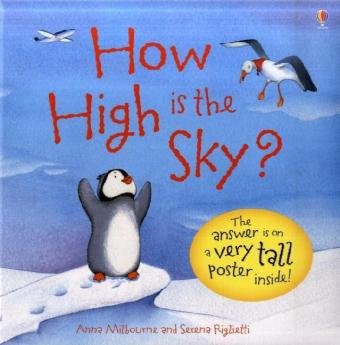
HOW HIGH IS THE SKY?
- Milbourne, A. (2009). How high is the sky? London: Usborne Publishing Ltd.
- Illustrated by Serena Riglietti, Designed by Laura Wood
- ISBN: 978074609584-3
- The book called “How High is the Sky” is a story about Pipkin the penguin who is curious about everything in the world. One day, he was wondering how high the sky is. He went on the adventure to find out the answer. On his adventure, an albatross, a gorilla the air balloonist, and rabbit the astronaut helped him to explore the world. Finally, he found out that the sky goes on forever, and his mom replied “there are a lot more to find out in the world.”
- I choose this book because most of children are curious about the world like Pipkin the penguin in the book. Especially at the age three to five, children’s desire of curiosity is vigorous. Children love to explore new things and always ask tons of questions. Thus, this book can give children a lesson; when there are curiosities in your mind, don’t hesitate to question. There is no right or wrong answer, and you can even get the answer by exploring the world by yourself. Also, this book helps children to learn the actual concept of the height through an extra information page in an envelope at the very back of the book. It is a folded piece of paper, which becomes very long when unfolded, to give children a sense of how high the sky is. This rather complicated information is explained with illustrations and simplification of the author.
- Illustrations are done by water color, and very delicately. Also, illustrator used various colors, so it looks very gentle and soft. Thus children will love it!
Provocation
- I would like to build the background knowledge of this book through showing them three different types of skies: light blue sky with some white clouds, dark blue sky with some clouds and complete black sky with lots of stars. So, first day, I will put picture of light blue sky with clouds on the ceiling all day. Next day, there will be second picture which is dark blue sky with some white clouds on the ceiling. Third day, picture of black sky with lots of stars will be on the ceiling, and last day, I’ll read a book to children. Through this provocation, children can picture in their mind that how the sky looks like when it goes up and up.
Four ways of presenting
- 1) I will prepare five pieces of thick paper and cover them with felt. Then, I will connect them with rings, which will allow them to fold together. Each paper will represent each height Pipkin has travelled. All the characters and backgrounds in each scene are made up of felt. As the story goes on, I will unfold, and by the end of the story, children will be able to see how long the paper is, which is relevant to how high the sky is.
- 2) This is a popular method used in Korea: I will use corrugated cardboard to make animal models for children to play with. I got all different colors of corrugated cardboard from Korea. Even though corrugated cardboard is a paper product, when I roll it to make a model, it gets harder, and I will use hard glue, so it won’t fall apart.
- 3) I will prepare all different types of miniature models in the story basket, so that children can do free play. For example, prepare 12inches Styrofoam ball and cut it in half, then it will become an igloo. Left-over felt can be snow on the ground, and so on.
- 4) I will make a crown with a laminated main character on it. A crown is made up of felt. Children can put on a crown and perform a role play.
Extension
- 1) I will ask the question to children: “What would you do and where would you go if you were Pipkin?” and get the children to answer by drawing. Through this activity, children can let their imagination run free. I will provide children different types of art supplies such as; pencil crayons, markers, water color paints and so on.
- 2) I will introduce the sequent books to children, How Deep is the Sea, or How Big is a Million? This will provoke children’s curiosity even further, while teaching them a sense of measurement and numbers.
- 3) I will ask the question to children: “What else could be in the sky?” Then children will mention all different kinds of products. Gathering up all the answers, we as a whole class can make our own sky. I will provide children a large piece of paper as a background, and other art supplies and materials such as; pencil crayons, markers, recyclable cups and lids, cotton balls, tape, glue, and so on to draw and make whatever children want to. Through this activity, children can express their thoughts freely and widely.
A young girl is strolling through a toy store and discovers a box of crayons that are not getting along. She buys the box of crayons and brings them home. She spreads out all the different coloured crayons so that they can see each other. She creates a picture using all the colours by mixing them. The crayons admire the beautiful picture they created together. The little girl helped the crayons realize that every one of them is unique and that when they include each other they can accomplish more.
This book sends out a great message to young children about sharing and including others. The simple rhyming and illustrations give the children a clear understating of the value of teamwork and encouraging diversity. The children can relate to this story through their interactions with other children.
Using a layering effect with coloured pastels, created images that resembled a child’s drawing, made the illustrations. The exaggerated expression of the crayons brings comedy to the story and allows the children to easily see the problem at the beginning of the story and then see the problem resolved. The bright colours and use of every colour from a crayon box attracts a child’s attention. Children that I have worked with like to try and recreate images they see in books. I like the simplicity of these illustrations because they allow young children the artistic ability to draw the images.
Provocations:
In order to have the children interested in The Crayon Box that Talked I will promote the idea that in order to accomplish some tasks teamwork is needed. In order to do this I will lay out a large sheet of white paper on a wall or the ceiling. On one end of this paper there will be some green grass and at the other end there will be a blue cloud. The children may realize that there is a large gap between the grass and cloud. Another way to provoke the children’s interest will be to have an empty felt crayon box on a felt board. Each day I will add a felt crayon outside of the crayon box. Children might wonder why the crayons are not in the crayon box.
Ways of telling a story:
1. Felt Story: I will either make the felt story by using a variety of coloured felt, scissors, and a glue gun or purchase the felt set for this book from kinderteacher.com for $15.00.
2. Finger Puppet: Using a thin glove and different coloured felt, I will create finger puppets resembling the crayons. For the crayon box I will cover felt over a cardboard box. The box will have a lid that opens, allowing the crayons to pop out and the bottom will be open, allowing my hand to fit though.
3. Interactive Story: I will create five different coloured crayon tips. The tips will resemble hats for children to wear. Each hat will be made out of thick art paper covered with different coloured felt. For the crayon box I will get a folding laundry basket from Ikea and stitch Crayon Box on the front. The story will start off with the children away from each other and in the end they will fit together in the crayon box.
4. Story Line: Using a clothesline, small clothes line pins, and the felt characters or laminated characters from the book I will create a moving story. Certain characters will be pulled along the clothesline, while some will be attached to a popsicle stick and moved along manually. This way of storytelling has the option of being participation based.
I will stop and have the children wonder on the page with the blue crayon saying, “something is very wrong”. At this point in the story, children can see that the crayons do not like each other and their expressions are unhappy. I will ask the children “I wonder what is wrong?” and “I wonder why everyone is so unhappy?”. I will also have the children stop and wonder on the page the crayons are dancing around the page “watching till I was through”. The children can see that the crayons are happy, but they have not been told why yet. I will ask the children “I wonder why they are getting along now” and “I wonder why they are all so happy?”. I may not chunk this book because it is a very short story and it would interrupt the rhyming scheme. However the page “I took it home with me” would be the best place to stop because the children are left wondering why the crayons are not friends, why the little girls would bring them home, and what will she do with them. At this point in the story there are a lot of wonders, if I were to chunk the book here, I would have the children colour with crayons. It would be interesting to see what they would draw at this point in the story.
Extensions:
1. Colour: Using the long piece of white paper from my provocation with the grass and the cloud, I will lay it across the ground. I will have children pick out a colour and have them draw together. I will encourage them to blend their images together. I might even incorporate paint into this activity to have the children see the different colours created from blending. After this activity, I will post their sharing experience in the same spot the blank picture was placed.
2. Parachute: This activity will take place outside. After parachute safety rules are explained, I will have the children form into a large circle around the parachute. As a team we will raise the parachute into the air and play age appropriate games. Afterwards we will place the parachute on the ground and re-form a circle around it. We will discuss how a team was needed to play with the parachute, that one would not do it alone.
3. City: I would put the children into separate groups and have them build together a house out of blocks. Once the children finished their homes I would ask them to find a way to connect each home. By working to together building roads or moving their homes closer, they will have succeeded in making a city. This activity will provide the children with a physical challenge and problem solving to move their own group creations into a larger group. The city could continue to build.
Reference:
DeRolf, S. (1997). The Crayon Box that Talked (M. Letzig, Illus.). New York: Scholastic Inc.
The box of crayons that talked on PhotoPeach
Wood, D., & Wood, A. (1984). The Little Mouse, The Red Ripe Strawberry, and The Big Hungry Bear. Child's Play (International) Ltd.
ISBN: 0-85953-012-4
This beautiful book by Don and Audrey Wood is an intriguing conversation between the narrator and a small mouse. The mouse is intent on picking a delicious red ripe strawberry, but is alarmed by the narrator’s warning about the big hungry bear, who “loves red ripe strawberries”. The mouse attempts to hide, guard and disguise the strawberry in attempt to protect it from the absent bear. This book is wonderful for children 3-5 because of the beautifully detailed illustrations, simple text and humour as the mouse tries various ways to save his strawberry.
Children are drawn to the cute little mouse and how his animated expressions change throughout the story. The storyline is simple and easy to follow, . with enough repetition so that the children will soon be able to anticipate what is coming and chime in along with the reader. In the end, the mouse shares his strawberry with the narrator, making it impossible for the big hungry bear to find it. The mouse and narrator’s “win win” solution is a great ending to a captivating picture book. This simple story is also humorous and interesting to adults. The identity of the narrator is unknown, but has the reader wondering if a very clever bear might have “out-foxed” a little mouse.Originally released in 1984, this book is timeless and the subtle reminder about the benefits of sharing resonates with both children and adults.
The illustrations are beautifully rendered in soft pastels and fine detail, bringing the story to life.The fuzzy texture of the little mouse tempts us to stroke his soft looking fur, and the ripeness of the red strawberry makes our mouth water.The mouse’s animated expressions change from pleasure, alarm, fear, panic, and back to pleasure as the story progresses.
This book is quite simple and short so I would not chunk it, however there are many good places to stop and wonder, or ask the children to predict what will happen next. Even before opening the book I could read the title “The Little Mouse, The Red Ripe Strawberry and The Big Hungry Bear” and then ask the children to predict what the story is about, and what will happen. On the second page I would stop and wonder why does the mouse want to pick the strawberry? What will he do with it? There is also room to discuss how we know when strawberries are ripe, and not ripe. At the very end of the book you can wonder where the big hungry bear is, and get the children to provide their guesses.
One great way to generate children’s interest in this story is to explore the look, feel, smell and taste of real strawberries. Providing a base of appreciation and familiarity for the fruit will give a deeper connection to the mouse's desire to save the strawberry, and perhaps the bear’s desire for it. It would be best to do this in strawberry season when the fruit is relatively inexpensive and readily available. I would begin with an exploration of how a strawberry looks, by having children use magnifying glasses to look closely at the parts of a strawberry, anddraw or paint what they see.The children can, share their drawings with the other children, commenting on what aspects of the strawberry they accentuated (shape, seeds, colour, etc.). I would then cut the strawberries in half and invite the children to explore the inside, using the magnifying glass and painting or drawing how it looks to them. Finally, time to taste the strawberries! I would tell the children to pick up the strawberries, describe how they feel and smell, then ask them to taste them and describe the taste.Planting/ tending to strawberry plants would give children an even deeper appreciation for the process and time it takes to grow a perfectly red ripe strawberry. If you don't have garden space you can easily grow plants in small pots.
This story could easily be presented on a magnetic board,, by attaching magnets to the back of sturdy pictures of the mouse, ladder, strawberry, chains, knife, etc.It would be also be fun to display different scenes on the four sides of a cookie tin. I think that turning the cookie tin to reveal the next scene would build anticipation and excitement for the children. I would need an alarmed version of the mouse as well as the happy version, and a whole and half strawberry.
I can find the pictures online or use a colour photocopier to copy the illustrations out of the book, and have them laminated before attaching magnets. I would like to find a background that resembles the drawings in the story, similar to the pastel style illustrations. The laminated pieces would be strong enough to be used on a story clothes line as well!
I would like to make a mini stage with 3 dimensional figures that have magnets attached, which can be controlled from below the stage with a magnet wand. I would need all the same pieces as the story using the magnet board, but I will make the pieces from model magic and glue magnets on the bottom. I believe the children would really enjoy performing the story themselves, leaving room for their creativity to reinvent/change the story.This would also help them realize that when they are playing with their other toys, they are also creating stories that others might also enjoy.
I would like to present this book as a felt story. I would need a little mouse, a ladder, a strawberry, a strawberry plant, a pile of dirt to put over the strawberry, a key, chains or chained strawberry, 1 pair of large funny glasses to disguise the strawberry, 1 pair of small funny glasses to disguise the mouse, a knife, and a strawberry cut in two. I can make the pieces by finding pictures online and printing them onto transfers. They can then be ironed onto white felt pieces.
Another way I can present this tale is by using story blocks. I will use square wooden blocks with pictures from each scene glued on different faces of the blocks.The story can be told stacking the blocks, lining them up or a combination of the two. I will sand the blocks to ensure they are safe to be handled by children, scan and print pictures from the story and glue them on the blocks, and cover them with modge podge or a clear lacquer. I would like to have one block with different mouse expressions on different sides, and another with different strawberries on all sides. I want the story to flow when told so I will have to coordinate the placement of each picture for ease of presentation. Perhaps I will write a script for the words in conjunction with how the blocks must be placed.I like the idea of creating something durable that the children can manipulate to tell the story themselves. They will have to use their thinking caps to turn the blocks to the right scene.
The activities that I suggested as provocations could also be a good extension activities. Growing or taking care of strawberry plants, exploring the sensory aspects of the fruit in addition to sight and taste. Perhaps a good activity would be cutting strawberries in half, working on the children's fine motor skills. Strawberries are quite soft so it would be appropriate to provide the children with plastic knives. This is a nice way to promote sharing, working with a partner.
Something many children wonder about towards the end of the story, is what the big hungry bear looks like. A good extension piece would be to have the children draw what they think the big hungry bear looks like. I like encouraging artistic expression without an example to copy, which encourages the children's creative and individual thinking. When there is nothing to copy or compare to, the opportunity for free expression is wide open.
Another extension that I would like to make is a discovery bottle. I will fill a small plastic bottle with rice or another small material, and put in small characters from the story. The children shake the bottle and find the characters from the story. I will include a mouse, a strawberry, a ladder, a chain and a lock. It is an activity that promotes attention and includes the excitement of discovery. It would be a good activity for a child playing on their own, and they can spend time discovering pieces of the story.
A song that would pair well with this story is:
Under a tree (clap clap)
behind a house (clap clap)
there lived a teeny (clap clap)
tiny mouse (clap clap)
she loved to dance (clap clap)
she loved to tap (clap clap)
but most of all (clap clap)
she loved to clap (clap clap)
she clapped all night (clap clap)
she clapped all day (clap clap)
she clapped to frighten (clap clap)
the BEAR away (clap clap)
(I exchanged the word bear with the original "Cat". If the children are familiar with the song they will find this funny and connect it with the story)
Another felt board "search" game that I could make with felt pieces is looking for a mouse behind different coloured houses. I can make many coloured house shapes from felt and hide a little felt mouse behind one. Have the children chant "little mouse, little mouse, are you behind the (name a colour) house?" Children love guessing games and this is easy to repeat with the rhyme.
Little mouse, the red ripe strawberry and the big hungry bear on PhotoPeach
Jeffers, Oliver. Lost and found. UK: 2005. Print.
isnb (10: 0007150369)
The book "Lost and Found" is a story about friendship. The book starts off with a penguin at the little boy's door step, without a second thought the little boy assumed that the penguin was lost and he took it upon himself to return the penguin to wherever it came from. He took the penguin to the "lost and found office" and asked if anyone was looking for a penguin, no one was. He went along asking birds and his floating duke. When none of those were help, he looked up where penguins came from, he found out they came from the North Pole. He and the penguin made a boat and set off in a mission to go to the North Pole to return the penguin home. As they set off the little boy shared his stories with the penguin and the penguin listened to him the whole way to the North Pole. As time passed they were finally at the North Pole and it was time for the penguin to go home, the penguin got off the boat and the little boy started to paddle his way back home. Before he could go very far, he realized that the penguin seemed a lot sadder to be without the little boy then to be "lost" as the little boy realized that maybe the penguin wasn't actually lost, he just was looking for a friend the little boy paddled back to the North Pole, looking for the penguin. He searched and searched for the penguin but he was nowhere to be seen, right before he was about to give up he spotted the penguin, they hugged and returned to the little boys house but this time as friends.
I really fell in love with this book for children ages 3-5 years old because I thought that the story line had a lot of meaning and children can learn about friendship, and they can also learn to be curious and to wonder about different things around them. The drawings in the book play so well with the emotions the author, Oliver Jeffers tries to portray for example: When he was outside asking the birds, he used a nice neutral color to make us feel what the characters feel in the book. And he also did that with the ocean with the way he drew the waves and the colors he used to go from day to night on the same page. In the day he put clouds and during the night he made the sky grey and added stars. I really enjoyed the illustration in the book because I felt like there were very calm and neutral the simplicity in it was what I thought was beautiful.
Provocations:
1. I would try and get the children to make their own North Pole, I would take white paper and hang it from one side of the room to another and ask the children to paint what they think the North Pole looks like, what animals they assume live in the North Pole.
2. Take a screen shot of the movie, make it colored and big hang it by the entrance so they can see it first thing in the morning, I will not ask them to look at it. I want them to look at it themselves; I will also have a smaller photo in the classroom.
3. I would pick 2 penguin songs and 2 friendship songs and sing them over and over again for over a week. I would sing one in the morning and one in the afternoon, I would do that in a pattern for example: "South Pole visit "and "if you're friendly and you know it" for day 1 and "Penguin family" and "Funga Alafia" for day 2.
Present the book:
1. Shadow puppets-
- props: cardboard, black construction paper, light, sticks, over head projector, a cut out of the boy and penguin, 'lost and found' office, the seagull, his duck and the boat.
-What to do: right as the children come in from being outside I would use one of the relaxing songs from my cd to calm the children down and slowly turn off the lights one by one. Then when all the children are seated at the tables and they are sitting calmly, I would ask children by tables or by what they are wearing that is in common with each other to go sit on the ground in front of the projector facing the area of my presentation. I would keep it a surprise by either handing out blind folds for them to wear for a VERY VERY short amount of time OR I would hang a huge bed sheet to cover the area that the shadow puppets would take place. I would tell the children that they can take the blind folds off when the music playing has come to a stop. And when they do that I will start telling the story using my shadow puppets.
2. Story vine-
props: string, cut out of the characters and it will take place outside
What to do: I will take the children outside and when we are all outside I would first do one of the songs I used to do for the provocation then I would hang one string from one tree to another, and if I can't find any then I would ask one of the other teachers to help me hold the line from one end to another. I will then start the story, this is one exercise where I would chunk the story and let the children tell me what to put next I would ask "I wonder who else beside the lost and found office did the little boy ask if they were missing a penguin" and so on till the story is done. At the end of the story I will want to ask if they could connect the songs to the story, I would help by giving them hints, I would ask questions like "I wonder if the penguin and the little boy can sing "friendly and I know it" together, after they have gone on that journey together"
3. Felt story-
props: again, the different animals and boy cut out shapes on felt material
What to do: I will start off by talking about how the boy went around and asked if anyone had been missing a penguin, then I will proceed to the when he is in the ocean and telling stories to the penguin and the last part would be the part where he drops the penguin off and right before he's about to turn home I would end the story. I would start a discussion with the children about what they "wonder" happened to the little boy and the penguin.
4. Movie:
props: TV - I would show the movie last, out of the four ways to present the story. Because I what to do: want them to actually witness the characters moving and interacting with one another. I would do this last before I present the story, I want them to experience the characters alive and see the emotion themselves then I would re-read the story to the children. Ask them questions about what they liked better the movie or the book, and I would try to make them wonder what the differences were between the book and the movie. The point of this would be so the children can feel free to ask questions, wonder and be curious infront of their peers because I know I didn't have that chance and I think it held me back a little bit because I was never comfortable enough to that, but I want to create some time for the children to talk. I would also use a talking stick that I will make that will be in the form of the the 'south pole' flag, on one side It would say "south pole" on the other side I would say "my turn" and I would tell the children that whoever has the talking stick is the child you would have to focus your attention on and etc. I would pass the stick around in a circle, and if a child hadn't yet come up with an idea, they can pass and they will have a chance with the talking stick once we go around the circle.
Extensions
1. I would like to print pictures of the penguin, multiple ones and hide them around the class room, split the children into pairs and do some sort of scavenger hunt and when they have found the penguins I want them to build an environment based completely on where they want their penguins to live. It doesn't have to be in the North Pole, I want to give them the chance to connect to the book based on their imagination. All this would be contained in a shoe box using paint, sticks, rocks pictures and anything else they want too.
2. I would go through each page of the book with the children and ask them what emotions they thought the little boy and the penguin felt, I would help them by the way I read the book putting emphasis on words the author used to show emotion. After I am done, and the children have come up with words that describe the emotion I would let them take pictures of each other acting out the emotions and make it into a book that way I can bring the children together, and talk about the friendships and relationships that the children might have with people in their lives that is like the little boys friendship with the penguin. I would use a camera, paper, construction paper, laminate (maybe) and use ribbons or staple to pages together into a shape of a book.
3. I would try to teach the children about the different animals that live in the arctic weather and I would want to teach the children about different animals, what they eat, what their strengths and weaknesses are, in what weather conditions they can live. I would want children to connect these animals to certain things in their life, so I would make a booklet with the different animals on them and on the other page trace out what is equilvent to that animal's weight or height. For example: page 1: would have a polar bear with two of its cubes and under them I would write little facts about the polar bear- where it leaves, why the fur is white, why it's so "fat", what it eats and etc. page 2: would be something children are familiar with or I can teach that is same weight or height of the polar bear example: an empty u-haul weights the same as a polar bear 2,210 pounds. I want this exercise to teach children about making connections with things that are not in their ordinary life with things that are. And I would also, let the children decide what animal they like out of the book, after they have chosen I will give them the animal traced out on a huge piece of paper and I will cut up magazines, newspaper, construction paper, paper towels and such for them to put in the traced out animal. I would also let them use crayons, googly eyes, string and other material to complete their animal. After that I would ask them what they liked about their animal the best and write it down underneath for them. And we can share them with everyone while they are done.
Lost and found on PhotoPeach
Jeffers, O. (2006). Lost and found. Hammersmith, London: HarperCollins
ISBN # 978-0-00-715036-6
This awesome book is about the boy who found a penguin at his door. The boy thought that the penguin was lost. So he decided to help the penguin finds its way home. Since the boy didn’t have ideas where penguins came from, he asked all creatures everywhere but he didn’t find an answer. He soon discovered that penguins live in the South Pole. The boy’s problem is how to get there. He asked the big ship to bring them to the South Pole but his voice was too tiny to be heard. So together, they decided to row all the way to the South Pole in good or bad weather for many days and nights. When they reached there, the boy was delighted and helped the penguin moved out from the boat. He said goodbye and floated away. But as the boy drifted away, he saw the penguin is sadder than ever. He then thought and realized that the penguin was not lost, but was just lonely. Quickly he turned his boat and headed back to South Pole. But when the boy arrived, the penguin is nowhere to be found. He kept searching but nothing works. Feeling sad and dismayed, the boy set off and headed back home. But as he sailed towards the deep, he saw something was floating ahead. And he found out that it was the penguin. Together, they headed home talking wonderful stories all the way.
For me this is one of the best books I ever read. Content is easy to follow and words are simple and repetitive with rhythmic pattern. It is highly interesting for small children because it is a book about animals and friendship. The illustrations or pictures are colourful that it will draw children’s attention. It is neither too bright nor too dull or boring. The medium used for the illustration is watercolor paint. The book has engaging illustrations with few words which is just right for the children who are learning to read stories. I was drawn to it because of its simplicity and childlike drawing. The mood evokes perseverance (in the sense that the boy didn’t give up finding ways and means to help the penguin finds its way home and rowing for many days and night and in good or bad day, even the waves looked like mountains), friendship, and care for others (because the boy was helping the penguin and when he realized that the penguin was not lost but just lonely, he rowed back to get the penguin and bring it back to his home).
Provocations:
A week before the storytelling of this book, provocations will be given. First day, the teacher will hang the poster of the penguin at the ceiling. It should be large enough to get the children‘s attention. Second day, the teacher will hang the poster of the boy the same place where the penguin was hanged. Next day will be iceberg in the sea, and fourth day, will be the poster of a row boat. The fifth day I will hang the sign “Welcome to the South Pole. Another way to provoke this story is to hang the stuffs of penguin and the boy on the rain stick. While the children lay down during their naptime, the teacher will pretend that the penguin and the boy will have a nap to each of the child for few minutes. The stuffs will touch the children’s arms pretending the penguin and the boy sleeps with them. After, the penguin and the boy might wake them up by tickling their tummy, feet, hands, arms and shoulder. And one’s tickled, they have to get up.
Presentation:
1. Story Scroll
One way of presenting the story is the use of a story scroll. The story scroll is made up of cloth with illustrations from the story. As the teacher opens the scroll in front of the children, the teacher will create a story where it came from. ” The prince and princess from ‘Readerland’ are sending us something to enjoy. Do you know what it is?” The children will then make a guess. The teacher will tell the children that there is a sticky note that says:
Dear readers,
We are so glad that you love reading a book. As your price, we sent to you our favourite book because we want to share to you the story. We love reading this story every day. Hope you will also enjoy it.
Love,
Prince Buck and Princess Let
The teacher will then read the story. She may chunk and stop somewhere and ask question that will create wonder to children.
2. Story Basket
The basket is covered with a piece of cloth just enough to hide the items inside. This will create wonder and motivate the children to sit and listen because the children may be excited what’s inside. The teacher may use her own words to tell the story. She/he will pull one item at a time depending on what she need. Inside the basket are:
- Stuffs of penguin, boy, and bird
- A small box for boat or a paper boat
- A little suitcase, a small book, small rubber duck, a styrofoam and small umbrella
- Aqua blue and brown scarves
- A cut outs of sun, stars, and moon
3. Clothesline Story
In this way, the teacher will display the clothes with illustrations from the book one at a time by hanging it on the clothesline. The teacher will show the illustration one at a time as she/he tells the story. Only illustrations are on the clothes, and no words. The teacher needs to memorize the story. If ever she will get lost, she can read the line of the story written at the back of each illustration. When the story is finished, the children can see the clothes hanging on the clothesline. They can see the flow of the story from beginning to the end. The materials for this kind of presentation are clothes with illustration of every page and a metal clothesline. The illustrations have a magnet at the back.
4. The Magnet Pad and The Cookie Sheet
The cookie sheet will be the board for the story. The teacher will use the magnet pad for the different characters in the story like the penguin, the boy, the bird, and the rubber duck. The backdrafts are made out of bond paper with a picture of the boy’s house (day and night), the lost and found office, the park with trees, the sea with iceberg, and the South Pole. The teacher may include rice (as rain), green scarf (as ocean) and the box (as boat) that will row the story to the other side of the cookie sheet which is the South Pole. The teacher will attach the magnet pad as she/he tells the story and change the backdraft depending on the story being told.
Extension:
1. The children can sing a song about penguin:
Tune: Eency Weensy Spider Tune: I’m a Little Teapot
I’m a king penguin I’m a little penguin, on the ice
Black and white I think the cold is very nice
Living at the South Pole I can hop around, first once the twice
Day and Night Come and dance with me tonight
One big egg I lay
And fish I eat I’m a little penguin, round and fat
I hold my egg Here is my beak, here is my hat
Upon my feet Winter days are coming, hear me shout
Please don’t toss my mittens out
Tune: five little ducks
Five little penguins, I once knew
Fat ones, short ones, skinny too
But the one little penguin with a red bow tie
He led the others because he likes to slide
He led the others because he likes to slide
2. The children can dance and move like a penguin with the music played. They may waddle, fly, and pretend they slide on the ice and having fun. The children may use props like scarves to let them fly.
3. They can make an art about penguin. They may draw and colour it. They may use play dough to sculpt a penguin with the teacher’s assistance. While doing it, the teacher can tell something about the penguin’s distribution and habitat and why humans and penguin can be best friend. The teacher can read another story about penguin titled “My Personal Penguin” by Sandra Boynton. It is a short story that could enhance the importance of friendship. For the additional knowledge about penguin’s habitat and distribution, log on to: http://www.seaworld.org/animal-info/info-books/penguin/habitat-&-distribution.htm
Lost and found on PhotoPeach
Book: The Squeaky Door
Author: Margaret Read MacDonald
Illustrator: Mary Newell DePalma
MacDonald, M. (2006). The Squeaky Door. New York: HarperCollins Publishers
ISBN: 978-0-06-028373-5
“The Squeaky Door” is based on a Puerto Rican folk-song called La Cama - retold in story format by Margaret Read MacDonald, popular author for retelling various folktales. In this tale, when staying with his grandparents, a boy is frightened by the squeaky door to his bedroom as he tries to go to sleep. The little boy keeps telling his grandmother that he is not afraid to be alone on the “big bed”, but he gets scared every time the door squeaks when his grandmother closes it. To comfort him, Grandma puts various animals in bed with him. In MacDonald's retelling, she tries a cat, dog, pig, and horse. When the bed breaks, the boy gets to sleep with his grandparents. The next morning Grandma oils the door, repairs the bed, and the child sleeps soundly after that.
One of the reasons I choose this book, is because I’ve met Margaret Read MacDonald and she’s an amazing story teller; this is a humorous retelling of an old Puerto Rican folktale. I’ve read it so many times at the Centre where I work and to my daughters and it’s always a success. The vocabulary is simple and funny; children definitely get drawn to the book. The animal noises and onomatopoeia, along with the varying speaking tones and dramatic pauses make this book fun to read aloud. After just a couple of iterations, Children were saying the repeating narrative for me and we all enjoyed yelling, "SQUEEEEAK!" I love Mary Newell DePalma’s illustrations; they are extremely hilarious, expressive, and colourful as the boy always has wide eyes that pop open whenever he gets scared and I also loved the animals sleeping in pyjamas, lipstick and eye shades, all tucked in to bed. The repetitive text and lots of noises to repeat encourages audience participation. The text features also a variety of different sized fonts, great to grab children’s attention and an Author's Note at the back of the book lists the Puerto Rican folksong that is the basis of the tale as well crediting a New Zealand storyteller, and a short story version, plus referencing one of several other versions. I would choose this book for 3-5 year olds because it’s a great way to introduce creative play. All the repetition makes this good for beginning readers. I also find that this light-hearted story is about a situation that we all can relate to: trying to help a young child fall asleep in an unfamiliar (or at least, non-routine) place. I see this as a good story time read-aloud, as well as successful one on one book for sharing. The idea of bringing many animals into the house reminds me of “Too Much Noise” by Ann McGovern. This could be used to emphasize sequencing and repetition in stories. Over-the-top humour and a satisfyingly predictable narrative make this tale one that children will likely ask for again and again.
Provocations for this book would be the pictures of the animals that appeared in the story can be displayed around the classroom, and then children can find it and attach them on a Magnetic board. I would also put in the Room a Doll bed, with a doll (Boy) and the stuffed animals that are in the story: a cat, a dog, a pig and a horse. I would say multiple times during the day: “I love the sound of a squeaky door, like this: SQUEAKKKKKKKKKK”.
Four Ways to Tell the Story:
1) Felt story- Felt stories provide hands-on learning and a great opportunity for children to develop self-worth and self-expression. It stretches their imagination and helps in developing the brain and memorization capacity.
To present my story, I need a felt board and the following felt pieces: Boy, Grandma, Big bed, Blanket, 5 pillows, cat, dog, pig, horse, can of WD-40, and a Tool Chest. I’ll find the pictures online and will print it out onto T-shirt transfer paper, iron them on white felt, then cut it.
Using a felt story for this book is a great way to present it; it creates elements of wonder when the children are waiting for the next piece to be placed on the board. Before each animal is brought in; “I wonder which animal Grandma is bringing next?” This will let children extend on their imagination. I won’t chunk the book, because this is not a long story and it also flows so nicely that I wouldn't want to interrupt the flow.
2) Puppets/Stuffed Animals - I will use puppets as another way to present the story after using the felt board with the same group of children, there are many advantages from using puppets as a way of storytelling. Puppets are one of the few toys that have lasted throughout the years as a favourite among both children and adults alike. This is mainly I suppose; because many of the toys on the market are a passing phase and what may be “hot” today will be “outdated” by next week. Puppets however never cease to capture the imaginations of their audiences as they create a fascinating imaginary world. They have the ability to break down barriers providing an effective means to initiate communication. Children who experience difficulties in communication and interaction can be motivated to open up when working with puppets. They can also be used to successfully teach young children about basic good manners, personal hygiene and overcoming the normal fears that small children experience. They can be used to develop children’s reasoning skills, as talking about ideas helps children to clarify their thinking.
Materials:
Puppets: Cat, Dog, Pig, etc...
Stuffed Animal: Big stuffed horse (or substitute any big animal)
Props: Tool box, WD-40
I’ll be Grandma and a boy doll can be the Little Boy. I’ll use a cat, a dog and a pig puppet for the first three animals, (add more if wanted, such as; duck, bunny, etc...) and then bring in a big stuffed horse for the last one (which breaks the bed). Grandma's tool box and a can of WD-40 are the only other props needed. I’ll repeat the same story four times in a week, which means I’ll get it just right by the third time (usually). But sometimes by the time the last one rolls around you’re a little tired of it. So maybe we can switch roles with this story for our fourth performance, with me as Grandpa and a child as Little Girl, it might be a nice change of pace. In the story, a little boy is scared of the squeaky door at his grandma’s house and each time he calls for her she brings an animal in to sleep with him: cat, dog, pig, then horse (or whatever I decide to add). So there’s really not a lot of puppetry involved, just adding them on top of each other. The real strength of the story is the strong pattern which easily elicits participation from the kids and the fun interplay between Grandma and the Little Boy. There are great refrains: the boy saying “Oh, no! Not meeeee!” each time Grandma asks if he’ll be scared. And of course the “Squeeeeeeeak!” of the door.
3) Basket presentation - I love the idea of a having a basket covered with a piece of fabric, that contains all the characters in the story; and as I’m telling the story get help from the children to try to figure out what animal is next to be put in bed with Little Boy.
Materials:
Doll bed, boy doll, grandma doll, stuffed animals such as: cat, dog, pig, duck, bunny, mouse and a big horse or big bear. Also a can of WD-40 and a Tool chest.
4) Story Act Out
Making children act out the story is another way to make the story more interesting, this will be my last method to present the story with the same group of children. Body awareness, coordination, flexibility, and spatial awareness are some of the physical skills a child gains through movement. A child's cognitive skills develops through vocabulary- building and creative problem-solving, while his or her social/emotional self grows through cooperation with others and a growing sense of self-esteem. Movement truly fosters the development of the whole child: body, mind, and spirit. Allowing children to act out the story can also help them improve their speech skills, listening skills, and develop appropriate voice modulation.
Materials
1) I need six T-Shirts. Four for the animals, one for Grandma and one for Little Boy. Each child involved will wear a T-shirt, with either a person (Grandma, boy) or an animal which will be printed on T-shirt transfer paper and ironed on. I will also use a blanket to represent the bed. A can of WD-40, and a Tool Chest.
Children can also use different animals that they want to replace the characters inside the story, I will have some animals printed and laminated, and children can use it around their necks (like a necklace, just wider).This is a great way to provide children’s creativity and imagination.
Extensions for learning:
The first thing that we can do after reading the book is to sing songs about animals, such as “The farmer in the Dell”. This song allows children to imitate different movement and sounds of animals. At the same time music allows children to improve their motor skills, improve their memory and build their confidence. We will also do some finger plays, such as “Doggie's House” and “Piggy on the Railway”, those excite movement, listening and verbal skills.
The second thing that we can do is making animal Masks. For that, we need: Paper (construction, coloured typing paper, craft foam, etc.) Cutting utensils: scissors, whole punch. Tie: Thin elastic cord. Decorating materials: markers, crayons, paints.
Directions:
1. Print mask.
2. Copy mask on chosen material.
3. Cut out masks and eyeholes.
4. Let children color and decorate.
5. Punch two holes on either side of mask.
6. Knot and staple elastic strip through holes, sized to fit the child’s head.
The third thing that we can do is to go on a field trip to the farm. Field trips are a great way for children to learn while having fun. Firsthand experience can provide children with information and a level of understanding that adds elements to their play, enriches vocabulary and enhances their overall learning. If a field trip is not possible (depending on the Children’s Centre location) we can do a Movement activity with the Animals, as we all know Children need physical activity every day. For this activity I will ask the child to make a pose related to the animal and I will take a picture with the stuffed or Puppet animal beside the child, Print it (in 8x10) and laminate it
Children can make not only the pose, but also, the noise of the animal as we hold up the different cards. I will talk to children about those animals (some basic information along with an interesting fact about each animal). This can also be a good starting point for other “farm discussions/activities”.
The squeaky door on PhotoPeach
Ramos, M. (2011). I am so strong. Gecko Press Ltd., U.S.A.
ISBN#: 978-0-9582787-7-5, Hardback
BOOK CONTENT
The cheeky story is about the “Big Bad Wolf” who, on a completely full stomach, walks through the forest and asks many characters “who is the strongest?” The wolf meets familiar characters like, a bunny, little red riding hood, the three little pigs and the seven dwarfs. They are all smaller than him so he asks to all, “who is the strongest?” All the characters respond by saying “of course you are”. The wolf continues his adventure through the forest feeling quite confident and proud that he is the “fiercest and the cruelest” in the forest. The book ends in a witty way, he comes across a tiny dragon and he asks “who is the strongest”, the little dragon responds, “my mother”. Once the wolf sees how big the dragons’ mother is he immediately changes his attitude and says “yes of course, your mother is the strongest”. The look on the wolf’s face says it all. This book is playful, funny and full of surprises and at the same time it is a great lesson that just because you think you perceive yourself one way, there are always others that have different ideas, “everything is relative, it depends on who you compare yourself to” (Ramos, R., www.marioramos.be). The content of this book does include words such as prudently, pathetic, gizzard, gumboil and gargoyle, the children might not know these words. I believe that they are a great way of creating conversation, since they are put in a completely sassy way, and are rectified immediately on the following page; this makes a great starting block for questions. We as educators could start the conversation asking the children: Simply, does anyone have any questions? Why do we use different words when we are angry? How does it make you feel if someone yells at you that way? Should we apologize for these words? I am sure this conversation will be one with passion and the children will be completely enthralled.
WHY WOULD I READ THIS BOOK TO 3-5 YEAR OLD CHILDREN?
I would read this book to 3 to 5 year old children because it is a modern twist on many classic fairytales. It takes the original fairytale and becomes something completely different. Will this difference between the classic story and a new way of seeing the wolf make the children wonder? Will it start many discussions? Children love playful, cheeky and familiar storylines, so will this book open up doors to understand that everything is not always the same and you can change stories and be creative in your own way? Between the classic and modern stories creates questions, curiosity and speculation. This book also introduces words that the children may not have heard before. However, if the story is told with enthusiasm the children may figure out the definitions to these new words on their own. It is unbelievable what a child can learn from just the context of the word, it will amaze you what they will understand. What a great time for a discussion for those who understand and those who don’t.
ILLUSTRATIONS
The illustrations in this book are so expressive. Mario Ramos is the author and the illustrator for this book (the children will be amazed by this), he said that children’s drawings are what inspire him to write and illustrate his books. The simple black and white lines of the wolf makes a big impact that the wolf is the definitely the main character of this book and he means business. Will the children recognize this and will it create different feelings? Will it provoke them to draw or paint the scenes or characters in the book? I believe that the medium used is paint, possibly acrylic. I also see water colours being used and maybe some chalk pastels. I love the contrast between the black and white medium and the use of colours, it creates more emotions. If you look very closely at the illustration on the front, you will notice that the baby dragons mother is actually there, take a closer look.
PROVOCATIONS
1) I would read the classic fairy-tales, “Little Red Riding Hood”, “The Three Little Pigs” and “The Seven Dwarfs” at circle-time and have the books in the classroom for the children to read and for the educators to read to small groups or one-on-one. This will let the children become familiar with these classic fairytales and help those children who do not have any background with these stories.
2) A couple days later after the classic fairy tale books were out, keep them in the classroom but add a picture of the wolf (probably a poster-board size) and behind the wolf put the humungous feet of the mother dragon in green, also on paperboard. Should we place it in an area where art supplies are available and see if they make any creations of their own? Move the pictures around the room and see what happens. Will this create questions and discussion?
3) A couple days later leave the original provocations out and then add other characters to the classroom. I would also like to sing some songs at circle-time that pertain to the classic fairy tales; I know a good one for the “Three Little Pigs”:
“Big Bad Wolf”
Tune “This Old Man”
Three little Pigs
Walking down the street
A big bad wolf they did meet
So they ran home fast
and shut the door tight.
No big wolf will get them tonight.
A little girl
Wearing red
Spied a big bad wolf
Who said
"What’s in you basket"
"May I have a bite"
"NO," yelled the little girl
Who ran in fright.
4) I wonder if there will be extra discussion throughout the classroom and at circle-time. Maybe I could have some of the characters on the wall by the circle and when we come together as a class hopefully this will provoke discussion and we can continue to make them wonder.
PRESENTING THE BOOK
1) Firstly, I would read the book and then later play an audio CD. I love to read because with the right enthusiasm the children become mesmerized. I would possibly “chunk” the book about 3 pages before the end and let the children wonder. Even though it is not a long book, I think it would be effective as the wonders are endless. Let’s see what happens until we read the rest of the book the next day. I think the children would enjoy the audio CD as it is a great different perspective.
2) Story Stones is a new and exciting idea, I love it. I would put my story on index cards so I have it by my side. I would then get some smooth stones and print out the characters on inkjet label sheets. Smooth out the labels on the stone (1 per character, maybe even some trees) and then just give them a coat or 2 of varnish and “voila”. Place finished stones on a tray and have some trees made out of sticks and paper and standing with a bit of play dough or clay. Then tell your story with the wolf meeting all the separate characters.
3) Light Table is a very effective way of telling a story. My decision for this is because I have a mini light table my daughter got for Christmas so with a little TLC we have a mini light board great for circle-time. So I will get tissue paper and cut out and trace the characters and make a small forest scene. I will then laminate all the items and we are ready to go. I will use press stick for the circle-time presentation to make sure it is secure. After we can put the characters on the light table for the children to create the story again from their own perspectives. If there is a larger light table to use that would be great.
4) Magnetic Tin was actually my first inspiration. I love how we can tell a story from all sides. I would get a large cookie tin or bucket and then make my magnet characters with magnetic inkjet sheets (available at Staples). I will get my images from the internet and edit them so they are proper size for the tin. I will then make some trees and paint a background with acrylic paint. I can cover it with mack tack to protect it. I will use the same index card with the story on it and then we are ready to tell our story.
EXTENSTIONS
1) I will let the children play with all of the items that I have made for this story. They will love to re-enact the story or create their own with all the different materials. Will this provoke the children to make up their own stories and create social interactions?
2) I will bring in some stones and put out some acrylic paints and let the children paint the stones. It doesn’t have to be the characters unless they want to but they can just paint the rocks. This creates connections.
3) Of course discussions will be big for this story. There will be a lot of questions about definitions, feelings, bullying, emotions and maybe even some language questions (boy do I have my hands full☺). I will be prepared to answer questions pertaining to these subjects. When we finish our discussions I will write down the questions and concerns of the children and find another book or story that will answer or at least help with their questions.
4) As the author “Mario Ramos” is inspired by the children, I will put out sketches from other children that drew his work along with his own and see what the students draw.
5) My audio CD will be left for the children to play if they so desire. Possibly, if we have a head-set available we will use that, otherwise we will just use a CD player. I would also like to sing the “Three Little Pigs” song (above) randomly throughout the week.
I am so strong on PhotoPeach