Showing posts with label Holiday Books. Show all posts

Friday, March 4, 2011

Valentine Surprise


Citation
Demas, D. (2008). Valentine surprise. United States of America: Walker.


As it says in the book:
ISBN-10: 0-8027-9664-8
ISBN-13: 978-0-8027-9664-6


Description
The book Valentine Surprise is a story about little girl-Lily- who wants to make a perfect valentine for her mother and starts to prepare it a week before Valentine’s Day. Although she tries hard to create a beautiful craft, she cannot make it and gets upset. On  Valentine’s Day, Lily gets an idea! What is she going to do in last day?


I have chosen this book for story time because of several reasons.

1) It is a seasonal book and great for story time or craft activity in February.

2) There are three main concepts: Valentine’s Day as special day, introducing new words we use as adjectives like skinny, fat or curvy and introducing days of the week.

3) Short sentences and nice and bright illustrations.

4) If Lily fails on her idea, it is just OK not to be perfect because her mother loves her forever for what Lily is from inside, her kindness and uniqueness.

I believe it is one of the best choices for 3-5 years old, as preschoolers start to understand the concept of 7 days as one week and each day has a specific name, the sequence of days as well as meaning of new words as adjectives like round or pointy. Moreover, they are more interested in hand-made craft as gift to beloved ones, as Lily does for valentine day.


Illustration
Coloring (Pencil, gouache and water color).One of the reasons I was drawn to this book was the picture of book’s cover. Lily is hiding behind wall as she has a peek and holds something in her hands. It makes me curious what is she going to do and what is happening in the book.
Illustrations are placed in white pages that draw my attention as I like this style of illustration with blank background.
These pictures provoke children to follow the book to the end as illustrations are not busy. The base is white and some illustration is placed in different parts of page that makes it interesting. Children can make a connection with Lily’s feeling such as happiness, excitement or concern. Even the font of words is creative enough to draw reader’s attention; for example, the font of word “heart” as skinny is really skinny or “fat heart” is really fat. Children enjoy watching beautiful drawings in the book as these pictures are simple but elegance and interesting. The whole page is white and some corners are colorful with watercolor and crayons that make the picture soft to look at. Beside Lily as main character, I have noticed there are some other characters (two kittens) in each page that have a connection to the story somehow. However, they are engaged with Lily in making home-made present differently. Personally, I enjoy reading story in story type because it requires more attention to find out what is going on in details.


Provocation
One of the ways to provoke children interest and curiosity is to look at the story by introducing the differences in the shapes of heart. One day before Valentine’s Day and story telling, we can print out and cut different heart shapes in a large amount and place them in the different corner of center like shelves, between toys, on chairs, cubbies, book corner or under table before children start the day. We can tell them that we lost some heart shape pieces and if some one finds it, put it on felt board. In fact, we should follow them by close observation in their conversation about how different each heart looks like. We should allow them to see and touch each heart piece in order to make a connection between what they see now (activity) and what they learn tomorrow (story). For example, if we give children an opportunity to see pointy heart shape by eyes and touch the point edge of heart by finger or compare it by curvy one, they understand the word of pointy quickly as we read the story tomorrow.


Four ways of presenting a book

1)    Story basket
2)    Felt board
3)    Children participation
4)    TV Screen
Story basket
Material: 2 dolls as mom and girl, 7 different shapes of heart (stuffed or laminated) and 7 laminated cards representing seven days of week.

I totally agree with what Susan Munzer-Briner mentions about benefits of covered basket to children in her book “you usually have the children’s full attention. Everyone is glued to what is happening.” (Learn to Play-Play to Learn, P 54) It would be easier to pick up items one by one from basket each time as we tell the story if we place the items in sequence of needs. I’d like to start and finish the story by saying “once upon a time” and “the end” so children have an image in their head about beginning and the end of story. We can use the cover of basket as stage of story. While we start telling story, we bring out items like the days of week and stuffed heart in right sequence according to the story. By the end of story, stage should be divided to seven section represent seven days of week.
More over, it would be interesting to put the basket in the shelf couple days later as children become excited to see the basket, play with material and make their own story.
While I present the story, I wonder and pause in some parts of story such as Lily’s new idea and how to solve the problem.

Felt Board
Materials: felt board, felt pieces (includes1 girl, 1mother, 1 bed and blanket, 1 scissor, 7 heart shapes, 1 calendar of weekdays, sun and moon)

I am a big fan of felt board as one of the most interesting way to represent the story, because children have a wonderful opportunity to see, touch and hold in their hands the characters of story. By making felt board and pieces available for everyone in free play, children have opportunity to expand their imagination and share it with friends; therefore, it assists their cognitive developments as well as social skills such as communication and cooperation.
Making a calendar by fabric and name each day of week on it was fun part of preparing felt pieces. I also add some extra pieces such as sun and moon with star in order to show children how long one day is with sun and moon in semicircle. As I tell story “sun comes up and it’s morning (I show Monday card)….Lily tries to cut out a nice shape of heart, but she couldn’t….she was tired, so she goes to bed (I show moon with star….), next day I show sun is up (now Tuesday card) and so on…..

Children Participation 
Materials: 2 headbands as Lily and Mother, Days of week (7 cards), 7 shapes of heart, a string and some cloth pin.

One of the ways to present the book is acting the story by children. It has a positive influence on child’s cognitive development, communication and social skills as they have an active interaction with peers and are engaged with story in details. It is required children to listen carefully and cooperate in order to act properly regarding to the sequence of story. Two children play roles of Lily and Mother. Seven children play a role as seven days of week and seven other children become different hearts. When I start to tell a story, children act their roles as they hear. At the beginning children as days of week stand in sequence and wait for Lily to join them one by one. For example, while I say “On Thursday (I point at child with Thursday tag) Lily (child as Lily goes to Thursday child) makes a forth valentine, but it is too curvy (and child as curvy goes to Thursday and stands with lily. Lily moves forward to next day and so on. The other way is each child (each day of week) joins to Lily and stand beside previous day as I tell story. By the end of story, there are 7 children standing as 7 days that make one week. As Lily got an idea, children as heart comes together and use pin cloth to attach it on string and make a perfect present for Mom.


TV Screen
Material for making TV screen: Cradboard box, cardboard tube, long paper, scissors, tape and print out pictures from book.

How to make a TV screen:


I prefer to tell the story in my words and use the TV screen at the same time. It is a wonderful experience to see children’s reaction to the story as something moveable in the box and they look forward to see what will happen and what is coming in the next scene. I like TV screen as something new for telling a story because child as same as I likes to make his/her own TV screen and makes up own story and then draw it on the paper. I had a same experience to make my own story in TV screen when I was a child. I remember my audience such as my parents, siblings and friends enjoyed watching the story in different way. I can use different papers for different story and I am still eligible to use drawing and coloring, print pictures or calendar photos as background. It depends on story and creativity.


Wonders

v I wonder what Lily wants to make.
           
v She runs out of colorful papers and has not finished her work yet. I wonder how she feels now. I prefer not to say her feeling and wonders how my feeling and children feeling would be.
v  
v I wonder what I should do if I was in her situation.
v I wonder what she is going to do as it is almost a valentine day. What is her idea?
v I wonder what children decide to do if they face a same situation.
v I wonder what is her mother feeling and reaction when Lily says “I tried to make you a valentine but it did not turn out right”.
v I wonder by the end of story how Lily’s feeling?
Extension

1)    Song for days of week :
 * Sunday, Monday            Tuesday, Wednesday          Thursday, Friday, Saturday (2)

Each day, I sing a song related to that day.

* Today is Monday (2)       that’s what it is today        
Today is Monday (2)       that’s what it is today 
Moooooooooonday!!!!!


2)    Craft of valentine in February.
       Materials: construction paper, scissors, crayons and the storybook on the table.
 I believe the book itself is completely a provocation for children. So, I just leave the book on the table and some papers and scissors. Hopefully, some of them might start drawing a heart and cut it out. They might start to compare and see the differences or similarity between hearts they make. Sometimes, some children are more interested to drawing and coloring different shapes of heart like small, big, skinny or chubby one.


3)    Craft
Cut the whole seven shapes of heart out of foam (pointy, round, square, curvy, skinny and fat) and leave them on the table with crayons and papers. Those hearts should be made of foam as the idea is to provide an opportunity for children to get familiar with the concept of some words used as adjectives such as pointy, skinny or square by allowing children to observe, touch, hold and trace the hearts on the papers.


4)    Non-fiction book
One of the concepts of book is introducing days of week to children. It would be a good idea if I use non-fiction book as extension. The book I chose called Talking about time: days of the week by Jilly Attwood. The book is about different activities children do each day of week and at the last page of this book, each name of days come in a sequence and show the order in clock turn.

Thursday, April 22, 2010

Spot's First Easter


Hill, Eric (1988). Spot's First Easter. London: W. Heinemann.
             ISBN: 0-14-055299-5
This is a wonderful lift-the-flap book about a cute little dog named Spot that is very excited about his first Easter. The Easter bunny has hidden some eggs around the house for him and his best friend Helen to find. Children love the Easter bunny’s appearance on each page reminding the reader how many more eggs are left to find. This help the children improve in their basic numbers, counting and pre-reading skills. I enjoyed this book because it keeps children engaged in the story and participation in guessing where the eggs may be hiding. The lift-the-flap helps keep the children attentive and exited to keep reading; allowing them to read it over many times without getting bored.

3 Ways of Presenting The Story:
-read the story to the children and stop after each page to see if the children can guess where the Easter bunny had hidden the eggs.
-use the felt board and allow the children to calculate how many eggs are left.
-use the puppet on the stick. Place the Easter eggs around the room, and the children will use puppets to find the eggs.

3 possible extensions:
-Easter is the celebration of new life which is a great opportunity to take the children on a field trip to the farm to show them the different forms or life.
-Dyeing the eggs represents a traditional Easter activity
-Play Easter songs or games such as “who stole the egg from the Easter basket?”

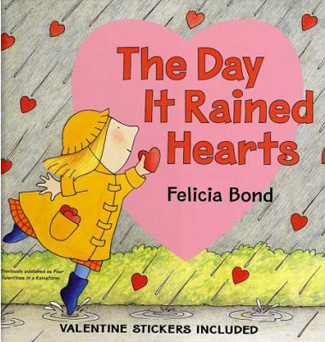
The Day It Rained Hearts


Bond, Felicia (2002). The Day It Rained Hearts. New York: Laura Geringer Books.
           ISBN: 0-06-001078-9
This book is about a little girl names Cornelia Augusta who went for a walk when it all of a sudden started raining hearts. She caught many different hearts and took them home soon realizing that each heart was different in its own way. She begins to make valentine cards out of the hearts for her special friends which she then mails out later that day. After that afternoon, it didn’t rain hearts ever again but she found other ways to collect hearts for her friends. This is a great book for children in pre-school because it gives them ideas about how to do nice things for their friends. It shows how to be thoughtful by using your imagination in order to make each card special for the people you care about most.


3 Ways of Presenting the Story:
-use scissors to cut out different sizes of hearts and characters out of a magnet sheet. Place the cut outs onto a cookie sheet allowing the children to tell the story to themselves.
-use a stick puppet so that the children could participate in the story.
-read the story out loud and once you reach the end of the story, have a discussion with the children about their thoughts and emotions.

3 possible extensions:
-sing song like: if all the rain drops were lemon drops and gum drops?
 Or song likes: skidamarink a dink a dink/ skidamarink adoo   I love you
-discuss about the history of valentines’ day and how did it start?  
-After reading this book, I could play the matching game with children.  

Festivals and Celebrations


Osorno, Julia (1994). Festivals and Celebrations. London: Islamic Publications.
ISBN: 0948656514 

Nowruz is the Persian New Year that starts on the 21st of March which is the first day of spring. It is celebrated in Iran and many other parts of the world as well such as Turkey, Tajikistan, Azerbaijan, Georgia, Uzbekistan, Kazakhstan, and some parts of Albania. This book is about the preparation of the New Year. It has great illustrations with colorful pictures for children between the ages of 3 and 5. People prepare for the New Year with spring cleaning and new clothing. For Nowruz, it is tradition to set up a “Haft Sin” which is a table full of Persian goods to elaborate the joys of life and family. These goods include apples representing beauty and health, green grass or wheat sprout symbolizing rebirth, vinegar for age and patience, oleaster representing love, coins for wealth and garlic symbolizing medicine. Decorated eggs are displayed out on the table representing each member of the family and fertility as well as a mirror wish displays honesty and cleanliness. Last but not least a bowl of gold fish is laid out on display to represent life. All of these items are believed to bring good luck and prosperity for a New Year. The celebration of Nowruz lasts 13 days. On the 13th day, the tradition states that the family should go out for a picnic and spend time together to remember the good memories of last year and wish for prosperity in the upcoming year. I really enjoyed reading this book because it displayed many beautiful illustrations and described in great detail the diversity of different cultures celebrating a New Year in unique and original ways.

3 Ways of Presenting the Story
-Use a felt board to create colorful pieces of the seven symbols used for the Haft Sin.

- Read the story out loud and discuss with children what each symbol represents.

- Use a story basket: Have a basket filled with the Haft Sin items such as the apples, eggs, coins, garlic, mirror, vinegar and oleastar. Pass them around so the children can experience a more hands on way of understanding the story.

3 possible extensions
-Before I introduce the book to the children, I will set up the Haft Sin table as a provocation allowing children to observe and understand the meaning behind the symbolic goods displayed out on the table.

-I could create a world map displaying the countries around the world which celebrate Nowruz. 

-We could keep the gold fish as a pet after the celebration allowing the children to take part in the responsibility of the fish’s well being.

National Aboriginal Day


Hudak, C. Heather.(2010). National Aboriginal Day
     Alberta: Weigl Educational Publishers Limited

ISBN: 978-1-55388-521-4
This book would educate children about the contributions made by the Aboriginal People towards shaping Canada and the Government of Canada commemorating this by marking June 21st as the National Aboriginal Day.   The day coincides with the first day of summer. This book of facts familiarizes young children with the history and traditions of the First Nations, Inuit, and Métis. The content of the book is in simple and short sentences for young children’s understanding.  It gives a wide range of knowledge in just ten pages, and is short enough to hold any preschooler’s attention. 
The images are all prints of photographs; showing full size pictures of the colorful traditional dances, the cultural artifacts of the Aboriginal People and the landscapes of the country. The children will be drawn towards the sharp glossy photographs. The style and the layout, text framed with a border on the left side of each page and the photo images on the right of each page, are also very appealing for children viewing.
The teacher could dress in traditional Aboriginal garb and place some of the popular native items such as a lacrosse stick (or crosse), and bannock within the children`s view. Ask the children if they can identify the items. Let the children play with the crosse and taste the bread.  For many, this would be a new experience and an introduction to a different culture.

3 Ways of Presenting the Story

Narration: The pictures in the book can be used to enhance children’s imaginations and understanding of the customs and traditions of the natives of Canada. As the book is read and pictures are shown, the children will notice details and ask questions. The pictures and traditions can be compared with some of their own customs and traditions by having them share their own experiences. With repetitive reading, vocabulary is enriched and the facts become easier for the children to remember.  
Picture board: Create a flow chart with three sections on a wall board in sequence of the text in the book. Section one could include what National Aboriginal Day is. Section two could include the Aboriginal People’s games, songs, and dances. Section three would then include their traditional foods. The pictures can be enlarged and laminated. The children can help pin the pictures up as the book is read out to them. The active involvement of the children will keep them focused and attentive. 
3 Possible Extensions
Art: Set up the easel and have bright vibrant colors available for the children to use. Play Aboriginal music and ask the children to reflect on the book and paint their feelings and experiences. Display pictures of the traditional clothes, accessories, art, dances, musical instruments, foods, and homes for inspiration. Skills in coordinating music with painting are developed, and interacting with peers is enhanced.
Project: Have children work on collecting and displaying information on the life style, language, beliefs, customs, and traditions of Canada’s First Nations, Inuit, and Métis. Encourage children’s thoughts by listening to their questions and comments. Discuss and share their views in class. This would widen the children’s knowledge of the heritage of the Indigenous people of Canada.   
Field Trip: A day trip to the Squamish Lil’wat Cultural Centre, in Squamish, will make a very informative and an adventurous trip for children. They will be greeted with a welcome song. This will be followed by a guided tour of the museum and exhibits, a 15 minutes film in the museums theatre. The tour will be finished with a cultural forest walk and craft making. For more information call 1-866 441 7522 or visit www.slcc.ca  

My First Chinese New Year


 Katz, Karen. (2004). My First Chinese New Year. New York: Henry Holt and Company

ISBN: 0 – 8050-7076-1 
 This holiday story book is about a young girl’s experience in preparation for the coming Chinese New Year and the fun she has on the day of the festival. During the days before the New Year, there are different activities taking place at home with her family, each day having a distinct meaning and a purpose. This is followed by the much awaited parade where they get to see lion dancers, and school children playing drums and cymbals. At the end, the highlight of the parade, a brightly colored dragon puppet arrives.  Everyone cheers and hugs, wishing each other “Gung Hay Fat Choy,” best wishes for New Year, in Chinese.
The book introduces the Chinese New Year in a colorful and lively manner, which would make it very appealing to preschoolers. The details of the traditions are explained in short and simple sentences for young listeners to understand. The artist has used collage and mixed media to create the illustrations, making each page bright, bold, and vibrant in order to capture the interest of young children.
A very large and colorful puppet dragon would be placed for children’s attention. Most of the children may think it to be a dinosaur, when asked. A Chinese doll would be shown next. Along with the doll, the statement, “Here is a dragon and a Chinese girl,” and the question, “Can anyone help me guess what kind of a story this is?” would be posed. After a few responses, reveal just two of the festival items: the bright red envelop, and a miniature broom. This will interest them further and keep them wondering what the book is about. Then by reading the first two lines of the story with an exuberant voice, reveal the theme of the book “HOORAY! Hooray! Soon it will be Chinese New Year.”  The children will be both excited and interested now to have the story read to them.   

3 Ways of Presenting the Story
Cookie Sheet:  The story can be presented on two sides of the cookie sheet. Using acrylic craft paint, the background of the indoor scene can be painted on one side; and the parade, on the other. The girl and her family, the festive items, the colored red paper, the plum blossom plant, the broom, the bowl of tangerines and oranges, the table filled with the feast, the red envelopes, the lion dancer, and the dragon can be traced off of the book and onto strong cardboard. Peel off colored paper (available @ Urban Source) can be cut to shape and stuck on the front side of the pieces and a small magnet glued on the back. Detailed features on the pieces can be filled in using felt pen. Using a stronger magnet glued on a stick, the pieces can be moved along the tray, while gliding from the back. As the story is narrated, the children will be fascinated to see the three dimensional pieces move around the painted backdrop. At every introduction of a festival activity, the story can be paused for the children to wonder about the significance of each item in the New Year’s celebration. This would encourage creative thinking in children and build their knowledge of how the Chinese celebrate their New Year.    
Felt Board:  Illustrations from the book are easy to design and construct into felt board pieces. The colorful felt pieces of the girl and her family, the festival items, along with the lion, and the dragon puppets, will make the story very attractive and hold children’s attention. It is important to keep all the pieces aside in sequence behind the board when narrating the story. As each item of the festival item is placed on the felt board, pause and wonder about the significance of the item with the children. “Oh! I wonder why this is used.”
Narration:  The book has very colorful illustrations captivating children’s interest, while at the same time, influencing their imagination with what they see. As the story is read, the children can use the pictures shown, to determine the details of the events, how the girl is affected, and why each item and activity is important. After reading the story, have a few children recall some of the festival activities and items from the story. Then ask them if they can recall some of the reasons for the items and activities. 

3 possible Extensions
Exploration:  Have the children share information about their cultures. Encourage them to bring pictures or items from home, exhibiting their cultural festival or celebration. The library has many books for children on the cultures of the world. Pictures from these books can be photocopied and all the gathered information can be displayed and discussed showing differences and similarities. From this cultural exploration the children can begin to learn about different countries and how far they are from their individual family’s home town on the world map or globe.                                                                                                                       
Arts and Crafts:  Make a Papier-mâché dragon using wire-mesh frame for the dragon’s large head. Paint and decorate it with brightly colored paint and glitter.  Attach long yards of colorful fabric, large enough to allow children to go under and act out the character of the festival dragon safely.  This activity will be fun, energizing, and thrilling for the children. The children can also make lanterns, which are a part of the festival, and can be taken home.
Show and Tell Game:  This fun activity involves the children being asked to match an object with the corresponding festival activity from the story book. For all the children to take an active part and have a sense of belonging, their cultural festivities may also be included in the activity. This will widen children’s knowledge about the diversity of cultures surrounding them.    
                                                       

Bear Stays Up ForChristmas


Wilson, Karma. (2004). Bear stays Up for Christmas. New York: Margaret K. McElderry Books

ISBN: 0-689-85278-9

As many other books in this author’s series, this book has also been a Best-seller. It has received numerous awards and is highly commended for children ages three to seven years old. The story begins with the snoring bear being woken from hibernation, by his friends: the Mouse, the Hare, the Badger, the Gopher, the Mole, the Raven, and the Wren.  It is the day before Christmas and his friends want Bear to be part of the Christmas preparation, so they go through great lengths to keep Bear awake while they find a Christmas tree, bake cakes, hang stockings, and hum Christmas songs. At night, as the friends slowly doze off in the lair and the Bear stays up to wrap presents for them, Santa Clause quietly pays a visit to fill their stockings.  At dawn, when Christmas arrives, Bear’s friends awaken to the lovely surprise of gifts from both their friend and from Santa. The story ends with the friends slipping away quietly as the Bear goes back to sleep, covered warmly under a quilt his size, a Christmas gift he received from Santa.
For me, the most appealing feature of this book is that it is written in rhyming couplets. Each phrase is not more than one couplet long, making it easy to introduce young children to rhyming words and poetry. In this short story, the book has a gopher, badger, mole and wren, animals which children of young age group are not very familiar with; therefore, it is a good book to use to expand children’s knowledge of different animals that live in the forest. Short descriptive words have also been introduced in the text for enhancing vocabulary. Children love books that tell stories about bears and hares, thus the cover of the book highlights this interest provoking factor. The story and the graphics in the book are very appealing. It would excite many children to have the book read to them repeatedly.  The illustrations are large and in acrylic paint, gripping children’s attention. The essence of friendship and giving is well portrayed in this book, along with familiarizing the children with the activities take place leading up to and during Christmas.   
 
The picture of the bear sleeping in his lair and surrounded in snow, would be enlarged and laminated, to be used as a provocation. It would be displayed on a black background wall for the children to be able to identify the season on close observation. A soft mouse toy and a hare toy, representing characters from the story, would be kept on the floor near the picture.  This will make the children inquisitive about the connection between the three. The cover of the book would be covered to add further interest and curiosity about what the story may entail. Next, the children would be gathered close and asked thought provoking questions, such as:
1)      What do they think the bear is doing?                                                                                                            
2)      Why is Bear sleeping while the mouse and the hare are awake?                                                    
3)      What time of the year is it (eg. Summer, when the flowers are all blooming; autumn, when the leaves are all falling; winter, when it is cold; or spring, when leaves start to grow)?
Finally, uncover the book to get them to match their guesses with the animal characters of the story illustrated on the cover.  This will now intrigue them to listen intently to the story.
3 Ways of Presenting The Story
Felt Board: This activity will require a felt board and felt pieces representing Bear and his seven friends, Santa, a Christmas tree, a fireplace, some cookies and goodies, a few wrapped presents, and a blanket. The illustrations in the book are user friendly for tracing in order to make the felt pieces. The story has two sections where it can be easily paused in order to encourage the children to discuss and think about the book. First, when Bear stays up while the others are sleeping the children can be asked “Why Bear giggles and grins.” And “When all the gifts are opened, there’s one last surprise. What do they think is the surprise?”
Four Sided Cookie Tin:  Watching characters move using magnets, makes story telling an exciting experience. Take a square cookie tin or a tin wastebasket and paint the background in 4 sections to match the sequence of the story. Alternatively, a felt cover of a measured size, stitched/glued together, can also be pulled over the tin. The animals, the Santa, and the Christmas tree pieces can be made using a strong cardboard; colored, sticker paper on one side; and glued on magnet on the other. Glossy colored sticker paper is available in many colors from Urban Source, Vancouver. To move the characters around, use a long stick with a magnet at the end, inside the tin. When narrating the story, the two sections where you stop and discuss with the children can be enhanced by bringing the presents, goodies, and blanket (made of felt) out after they have made many guesses as to what the surprise may be.
Narration:   The story introduces many rhyming and action words with every turn of the page. By reading slowly, pausing, and asking the children to act out the scenes as the story progresses, their interest can be peeked. For example, “… snuggled on his floor, Bear sleeps soundly with a great big snore…”, “Dear Bear, GET UP…!”, “He stands with a stretch and a great big sign..” , “…  but his friends all frown….” These are all scenes that the class can have a lot of fun acting out.                                             
3 Possible Extensions
Have the children make all the festive Christmas items mentioned in the book: Set up a Christmas tree and decorate it with popcorn strings, bake fruitcake and cookies, cut and decorate stockings made from felt, wrap presents using small used boxes, and sing Christmas songs.  Many families have their own traditions when celebrating Christmas, thus the children can be encouraged to share this with their peers, thereby making them aware that there can be different ways of celebrating Christmas.

Dramatic play would be a good idea for children to act out the Christmas message of friendship and giving.  Children would act out the characters in the story wearing color capes, brown for the bear, white for the hare, black for the raven, red for Santa, etc. One of the children could be decorated with a string of popcorn and presents all around while others sing Christmas songs. Adding a little humor and animal mimicking would make the story more fun and interesting.

Using reference books from the children’s library, explore with them some other animals that live in the forest and some which also sleep through the winter. Having the ability to explore some of their theories, and ideas would be interesting for the children.  They could also display their research on posters around the room, giving them a sense o